
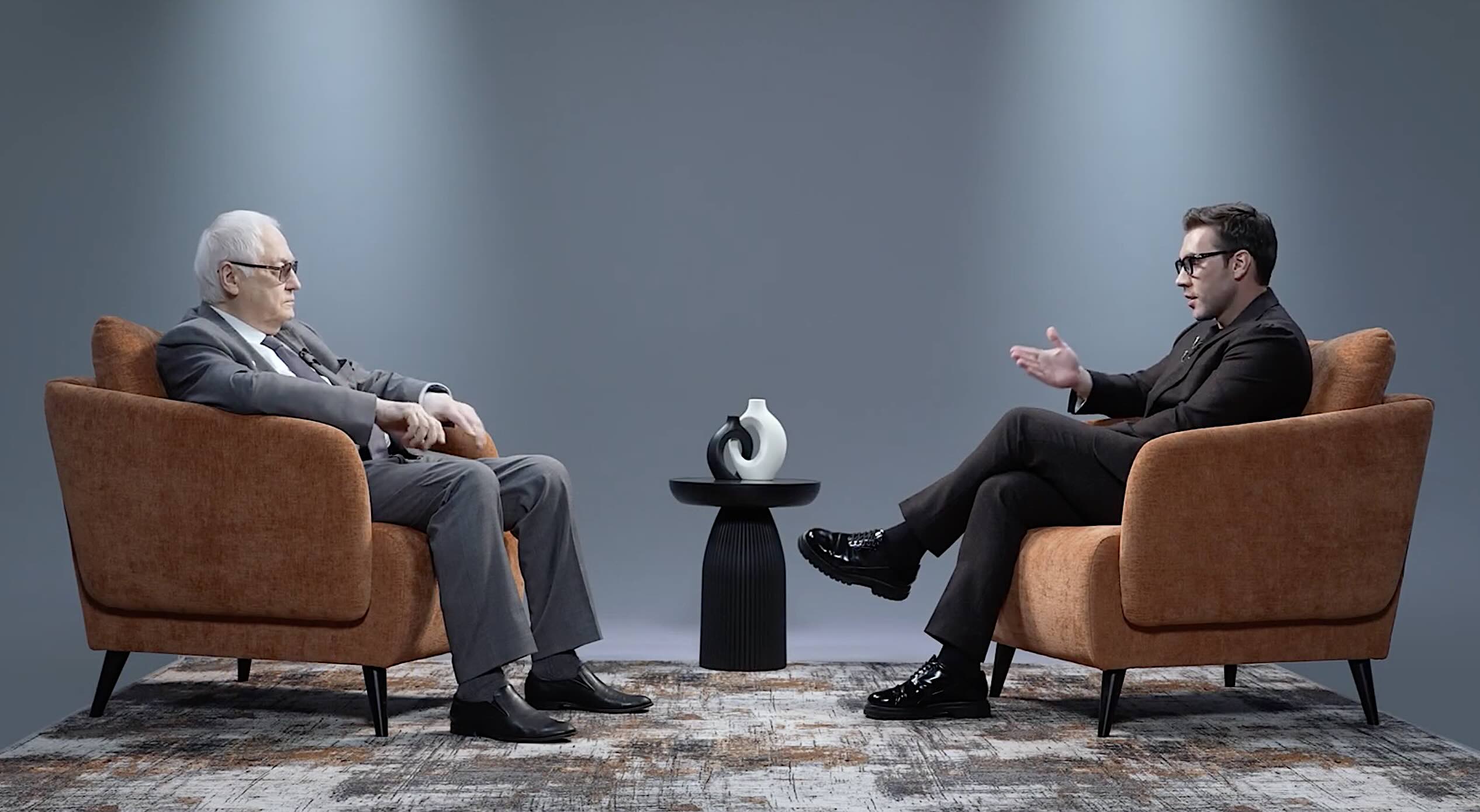
Russian Academy of Sciences academician Robert Nigmatulin, after his resonant speech at the Moscow Economic Forum, gave an interview in which he sharply assessed the state of the Russian economy, government incompetence, poverty, demographic crisis, and growing public frustration.
According to the academician, Russia's economic problems did not start because of sanctions or military expenditures. He claims that a faulty economic system has operated in the country for decades, led by people without sufficient education or professional experience in their fields.
“If we continue at the current pace, we will need 35 years – a third of a lifetime. But that is impossible. The nation will not endure it,” says R. Nigmatulin.

- Journalist Dmitry Kopentsev: Your speech at the Moscow Economic Forum caused a major reaction. When preparing for it, did you realize the response would be so big?
- Robert Nigmatulin: I did not expect it at all. This was already my tenth forum. I have spoken at all of them. When I saw what happened this time, I realized it was linked to the atmosphere in society. It is changing.
You know, it’s like a spark. Maybe the term "volatile mixture" isn’t quite accurate, but such a spark spread very quickly. And that is alarming.
I wouldn’t want society to be inclined toward any kind of rupture. However, my goal, like every professor’s, is for society to understand us and for the country’s leader to understand as well.
- Why do you think such a reaction arose precisely now?
- Apparently, everything is accumulating. Frustration is building up in the nation. Then anger appears. Many people live very difficult lives. That layer of anger isn’t very big, but it has increased. This is very dangerous.
I am against abrupt regime changes. Our history shows that major ruptures often end in tragedy. The February Revolution followed by the October Revolution – these were tragedies for the entire country.
Later came the transition from Stalin’s regime to Khrushchev. That passed more or less calmly. Then came Gorbachev – seemingly with positive ideas, but he quickly lost authority. When authority was lost, a state rupture occurred, and the country collapsed.
I only hope this does not repeat. That worries me deeply.
My goal is to warn. I want the message to reach both the state leader and the nation. We must preserve unity and change what needs to be changed.
The people running our economy are unfit. They need to be replaced.
- Did you coordinate your speech with anyone?
- Not at all. By the way, about a week ago I spoke similarly at a meeting of the Russian Academy of Sciences Presidium. The session topic was the challenges of the Russian economy. I said roughly the same things. My brother spoke about energy. But then it passed calmly, without any stir.
After the forum, I have been continuously invited and asked for interviews. My speech is constantly shown. When invited, I try to agree, because I want to further explain my thoughts.
The most important thing is this: yes, our situation is complicated by military matters, sanctions, all of which weigh on the economy. But that only additionally complicates the situation. The main problem is serious gaps in the organization of the economic system itself.
It is impossible to live like this for long.
- What is the state of Russia’s economy today?
- Since 2008, our GDP growth is approximately 1.3 percent per year.
From time to time, presidential May decrees are issued setting very important economic tasks. However, none of these decrees have been fulfilled since 2012.
Let me remind you with a simple example. In May 2012, it was stipulated that the minimum wage should reach 25,000 rubles. We seemed to approach that, but prices have roughly doubled since then. This means the decree was not realistically fulfilled.
The minimum wage should be evaluated not nominally, but according to real purchasing power.
In every country I visit, I ask three things: how much a liter of gasoline costs, what the minimum wage is, and how much a kilogram of regular bread costs.
In a normal country, the minimum wage should correspond to about 800–1000 liters of gasoline. If gasoline costs about 60 rubles, the minimum wage should be about 50–60 thousand rubles.
That is what it should be given our economic condition.
A professor’s salary should correspond to about 5000 liters of gasoline – that would be about 250–300 thousand rubles. But not 100 thousand, and especially not 50 thousand.
When you say this to those in charge of the economy, they do not understand. They are insufficiently educated. That is my main criticism.
- You speak very harshly about the tax system.
- Yes, because it is flawed. I was a director and always marveled: every quarter the chief accountant would bring a huge pile of papers I had to sign, even though everything had already been sent electronically.
Who came up with these idiotic rules? Who came up with these idiotic tax reports, inspections, and the entire system?
These were devised by the same people who run our finances. But they shouldn't be doing this.
Look at fuel. Taxes are taken from fuel, and then those taxes are included in the prices of all manufacturers. This affects industry, transport, agriculture, everything.
We have our own fuel. That should be our advantage. If fuels were not so expensive, industry and transport would develop and plane tickets wouldn’t be so costly.
But it is easy for the state to collect taxes on fuel. Specialists tell me that about two-thirds of the fuel price is government levies. These levies add burden to the entire economy, and then taxes are taken again from that same economy.
It is impossible to explain that to them.
- What does it mean that Russia has so many accountants and tax administration workers?
- It shows that everything is tangled and overly complicated. Russia has about 3.5 million accountants, and America about 3.1 million. The U.S. has almost two and a half times more population but fewer accountants.
The same applies to tax administration workers. We have about 120,000 of them, while America has about 90,000, although it has many more people.
These simple indicators show that the people managing this system are unsuitable.
The tax system has to be simple. This has been said so many times it’s tiresome.
For example, why does the employer pay my pension and social contributions? Why isn’t that explicitly part of my salary? I need to know how much of my salary goes to pension and social matters.
But it’s impossible to explain that.
- You also talk about pension fund problems.
- Yes. In any normal country, the pension fund is invested so its value grows and outpaces inflation. We don’t have that.
Inflation rises, but the real value of accumulated pension funds decreases. Prices go up, money devalues.
The retirement age is raised because the pension fund is not managed well. A person saves, but by the time they retire, inflation has eaten up a large part of that money.
That money burns away. Gradually, but it burns.
It is another example of state inefficiency.
- You accuse the heads of the economic bloc of incompetence?
- Yes. Economic bloc leaders—deputy ministers, ministers—come to the Academy Presidium, but they don’t know their fields.
Almost all economic bloc ministers lack proper education and work experience in the areas they lead. They are translators, sociologists, and the like.
This can’t be.
Industry sectors need to be led by engineers with organizational experience. Science must be led by scientists also with organizational experience.
You cannot expect a so-called manager to lead anything—science, space, industry, or a field they have never worked in.
Professionals must lead affairs.
- So this is a story about us often confusing malice with simple stupidity and incompetence?
- Yes, I think so. There is also a serious moral problem. In many countries, ministers, industry leaders are upper-middle class, but not wealthy. Here, constantly talked about is who owns how much real estate, what incomes they have.
Vice-premiers, vice-governors, regional leaders, ministers are arrested. It’s clear many of them own large real estate and receive income from it.
If they acquired that property legally, fine, go ahead and engage in that business. But then they shouldn’t enter the state apparatus.
Ministers in the state apparatus should be moderately well-off people, not the wealthy.
- You said at the forum that Russia remains one of Europe's poorest countries. Is that true?
- Yes. In terms of per capita income we are among Europe's poorest nations. Maybe some small states have similar figures, but among main European countries, our position is very poor.
And this has lasted for many years.
During Soviet times, we were not rich either. We envied the West, where capitalism was. That’s why we gladly went to the market.
But I want to ask: During the Soviet era, everyone studied free of charge in universities and received scholarships. Nobody paid for education. Now many pay for studying.
Where did the money that used to go to education disappear?
Students received scholarships. It was hard, but life was possible. A graduate student received enough to live. Now a graduate student gets about 8,000 rubles a month, but a dormitory for someone coming from another city may cost 10,000.
That’s why very few people enter postgraduate studies and science.
By the number of scientists per capita, we are now at the bottom. Big Russia has declined in this area. The number of scientists decreases.
The president has repeatedly said that spending on science must increase to two percent. But no real progress toward this figure is visible. In European countries it is about three percent, in Israel about five.
If we want progress, we need to raise science and society’s levels. But the number of scientists is decreasing here.
You can’t live like this.
- So this trend began even before the special military operation?
- Of course. The flawed economic practice existed long before.
In the Duma it was frequently asked: why were such huge resources kept in Western banks? After all, when you put money into a bank, you invest. Then income is shared between depositor and bank.
We invested in Western banks. Income from those accounts was small. And now we’ve lost that money.
They talk about $300 billion. Specialists estimate that about a trillion dollars in total were taken out of the country.
This places a heavy burden on society and the nation.
Some people begin to get angry. Doubt about the country’s future appears.
After the Moscow Economic Forum, President Vladimir Putin gathered his economic people and reproached them that their forecasts did not match. I think the forum and my speech reached him.
- But presidential decrees have not been executed for a long time.
- Yes. Almost all major decrees since 2012 have not been fulfilled according to main parameters. They were correct but unfulfilled.
The last important decree was in 2024. The demographic section absolutely will not be fulfilled.
- What is happening now with demographics?
- Our natural population decline is about 600,000 people per year. The number of deaths exceeds births by about 0.6 million.
This figure will not decrease in coming years.
If mortality were at Soviet-era levels, losses would be about 400,000. If at European levels – about 200,000.
Our mortality is very high, especially male mortality. Many men do not live to retirement age.
If counted over ten years, losses would be about 6 million. I don’t want to make longer forecasts because life is more complex than mathematical models.
Mendeleev once predicted that by the end of the 20th century, Russia would have 500 million inhabitants. His calculations were correct, but life went differently – revolutions, wars, civil war, massive human losses.
So for ten years we can say about 600,000 per year.
- How do you take all this personally?
- Hard. I have children and four granddaughters. They will have to overcome these problems. My generation is leaving, but it’s hard for me to watch.
I live well; I have enough. I’m an academician. But there are very few academicians. The main people in science are professors. And experienced, high-level professors have become poor people.
I said the minimum wage should be about 50,000 rubles. Some professors earn about that.
- Do you feel people are tired of poverty and constant survival struggles?
- Yes, I feel that. The main thing is disbelief.
Elections are approaching. Nobody believes in them. I don’t believe in these elections either because elections cannot be conducted that way.
Elections must trigger a discussion among people – what to do, how to live going forward. The discussion must be cultured, but it must exist.
We don’t have it here.
If there is no discussion in the Duma, then at least the head of state and government should meet with people who have different opinions.
Maybe it’s not necessary now to shake up the situation with street discussions where one crowd stands against another. But a serious dialogue is essential.
- Why is no alternative future vision proposed?
- Because no future vision is being formed. That requires intelligence. It is lacking. That’s a serious criticism.
- But Russia has intelligent, educated people. Why does such negative selection occur for leadership positions?
- Negative selection for leadership posts is the policy of the head of state. He must understand that this policy needs to change.
I say all this not to overthrow the government. Absolutely not. But the head of state must consider our views, including mine.
I have met the president. My impressions from conversations with him were positive. The last time was in 2017, when he invited candidates for the presidency of the Russian Academy of Sciences.
- What is your formula for measuring economic efficiency?
- You must look at investment growth and GDP growth. Over 15 years, investments in Russia increased by about 30 percent, but GDP grew by about 19 percent. If you divide 19 by 30, you get about 0.5.
That is a very poor efficiency indicator. According to it, we rank about 40-45th among developed countries.
There is also an inflationary pressure indicator. Ours is terrible. Investments often do not create real growth but rather go into inflation.
Economic growth should be paramount. But these bad indicators have persisted for decades.
We particularly studied the period from 2008 to 2023 and also look to 2024-2025. The situation is not improving but worsening.
Of course, the special military operation puts pressure, about 10 percent of GDP by our estimates. Sanctions weigh in. They work slowly but surely.
But even without sanctions, our economic figures were very poor.
- Why does Russia’s GDP grow at such poor rates?
- Because of inefficiency. For example, small business. It should be one of the most efficient parts of the economy. Small business makes consumer goods, finds buyers on its own, employs itself and others.
But instead, taxes on small business are effectively increased.
Small and medium businesses create 40-50 percent of GDP in developed countries. That is the foundation of the economy. Here it is only about 12-15 percent.
And the government constantly tries to squeeze more from them to patch budget holes.
This shows the quality of economic management.
- You spoke about industrial decline.
- Yes. In machine building, about 9.8 million people worked in 1990. In 1999, about 4 million. And in 2025, only about 440,000.
In light industry, about 2.3 million worked in 1990. In 1999, about 1 million. In 2025, about 300,000.
Meanwhile, we have about 1 million couriers and about half a million security guards – a total of about 1.5 million people.
Couriers often earn more than professors here.
They say this is the market. But that is an unhealthy market with no prospects.
Primarily because professors have been turned into poor people.
- Why don’t investors want to invest in Russia?
- Because returns are low. You invest, but the effect is minimal. Much goes into inflation.
If you think where to invest, you obviously choose China. Returns are high there. China's GDP growth is clearly connected to investment growth. The trajectory is almost straight.
In Russia, it is different: up, down, fluctuates. Efficiency is low.
Poland’s efficiency is also much higher than Russia’s. China stands out in this regard.
Investment security is also important – that investments aren’t stolen and are protected. But the essential fact is: efficiency is poor, returns are low, much goes into inflation.
- Much is said about inflation and the Central Bank’s high base interest rate.
- Yes. The Central Bank says a high interest rate is needed to combat inflation. But the main source of inflation is inefficient investments.
People invest in new production, often take loans. When base interest rates are very high, loans become inaccessible. This fights not only inflation but also investments.
High interest rates can be maintained briefly—one or two years—but only if during that time economic reforms are carried out, people and laws are changed, efficiency is increased.
We don’t have that. Investments are stopped, economic growth declines, and we sit waiting for the weather by the sea.
It’s pointless.
- What growth would Russia need to escape poverty?
- To get out of poverty in at least 10 years, the economy needs to increase one and a half times.
At the current rate, it will take about 35 years – a third of a lifetime.
But that is impossible. The nation will not endure waiting a third of a lifetime to escape poverty.
These are the numbers. We need to look at these numbers. I think neither the prime minister nor the president are properly familiar with them.
Sometimes I think: maybe they will invite me, us, those who talk about this. You cannot ignore science.
- How old are you?
- I will be 86 in a month and a half.
- And you’re still waiting to be invited?
- Of course. I feel good.
- I am not asking about your well-being. If they wanted to invite you, they probably would have done it earlier.
- There was one case around 2009. Vladimir Putin came to our expedition near Baikal. We took him diving to the Baikal bottom. It is a very strong psychological impact – to dive to a depth of one and a half kilometers.
We talked about some matters. It was not a very serious conversation, but later he helped us with funding for the research fleet.
True, I walked around offices for several years with documents he had signed. Officials did not react. Eventually, the Academy received an additional billion rubles for the fleet.
Before that, we had only 120 million. With a billion, we could restore the fleet.
Now new people have arrived at the Ministry of Education, and they are again destroying our fleet.
This is just one example of how ministries are managed. They think they are smarter than specialists.
- Why does small business in Russia only survive?
- Because it is not allowed to grow normally. If the economy is stagnating and the real economy is shrinking, tax rates must be reduced. That is simple economic theory.
If you reduce the tax rate, business finds it easier and begins to grow. Then the budget compensates for the lower rate through a broader tax base.
If you increase the tax rate, you don’t necessarily get more revenue. People start to cheat, retreat into the shadows, or close their businesses.
In the past year, about 700,000 to 800,000 entrepreneurs closed their activities. What improved from that? It means additional production decline.
They were warned about this, but nobody listened.
It’s sad. But if we grasp the problem, we can get out.
- You said Russia has no time and is late. How much time is left?
- If we start, it is still possible. But we are not starting.
We aren’t changing our economic order. The base interest rate is high, everyone is sitting waiting for something.
What are they waiting for? It only makes sense if economic order and cadres are being changed at that time. But there are no reforms.
Therefore, all this becomes meaningless. The main thing is not to be late. Because the number of angry people is growing. I feel it.
- Aren't you afraid yourself?
- I am worried. I worry about my children and grandchildren. When I get very sad, I remember what my mother and father thought when the Germans stood at Stalingrad.
I believe in a miracle. I cannot say who or how it will happen. I am not a religious person but I believe in a miracle.
And I believe in the wisdom of my people.
- What books would you recommend viewers read to better understand the economy?
- My brother and I wrote two volumes—"Macroeconomics. Russia and the World."
Now, of course, we would write those volumes even better and more understandably. We are not pure professional economists. We approach economics as mathematicians, as engineers.
And modern economists lack that.
Of course, there are classics like Paul Samuelson. People learned market economics from them.
We got involved in this area because we see very difficult and poor economic management.
We came from outside, so we see the system’s flaws better. Those who live in the system long get used to it.
You need to move from descriptions to numbers, to mathematical evaluation. We constantly work with figures and show how efficiency can be quantified.
- Many thanks for this conversation. I am a journalist, you are a scientist. We are not officials, we don’t run this country. But it seems to me we do quite a bit, at least by talking about existing problems. Thank you for your courage, because not everyone can speak so openly and honestly about problems today.
- Many people lack courage because they do not trust their knowledge. We have gathered experience and do not doubt our knowledge.
Comments
0No comments yet.